Introduction: A 3,000-Year Civilization
At some stage in late August 30 BCE, Queen Cleopatra VII Thea Philopator, the ruler we know today simply as the Cleopatra, took her own life in the city of Alexandria in northern Egypt. She had learned that her husband, the Roman general, Mark Antony, had also killed himself not long before this, sure that his cause in the Roman civil war with his bitter rival, Octavian, Julius Caesar’s great-nephew, was over and that the Roman armies that had landed across northern Egypt would soon capture him and bring the civil war to an end. Cleopatra almost certainly did not take her own life by having a poisonous asp bite her. This was a fable that gained currency when William Shakespeare included the story of a venomous snake in his play Antony and Cleopatra, first performed in London in 1607. Instead she most likely swallowed some poison. The story of Cleopatra’s demise is well known, but its wider significance is often overlooked. With her suicide in 30 BCE, the independence of Egypt came to an end.

The country would be ruled henceforth by the Romans, then later the Byzantines and the Arabs. Thus, the events of 30 BCE brought to an end an independent ancient Egyptian civilization, one which had existed since the late fourth millennium BCE, over 3,000 years earlier. In that time it had resulted in the Great Pyramids of Giza, the Sphinx, the Valley of the Kings, hieroglyphic writing, the magnificent temples of Karnak at Luxor and Abu Simbel, one of the most sophisticated polytheistic religions of the ancient world and an empire that stretched into the Levant, Libya and Sudan. Latterly it had even become the greatest centre of learning the world had ever seen through the development of the city of Alexandria with its famous library under the patronage of Cleopatra’s family, the Ptolemaic dynasty. Thus, Cleopatra’s death in 30 BCE very much the end of an era. This is the story of the long and dynamic history of ancient Egypt.
Narmer and the Emergence of Ancient Egypt

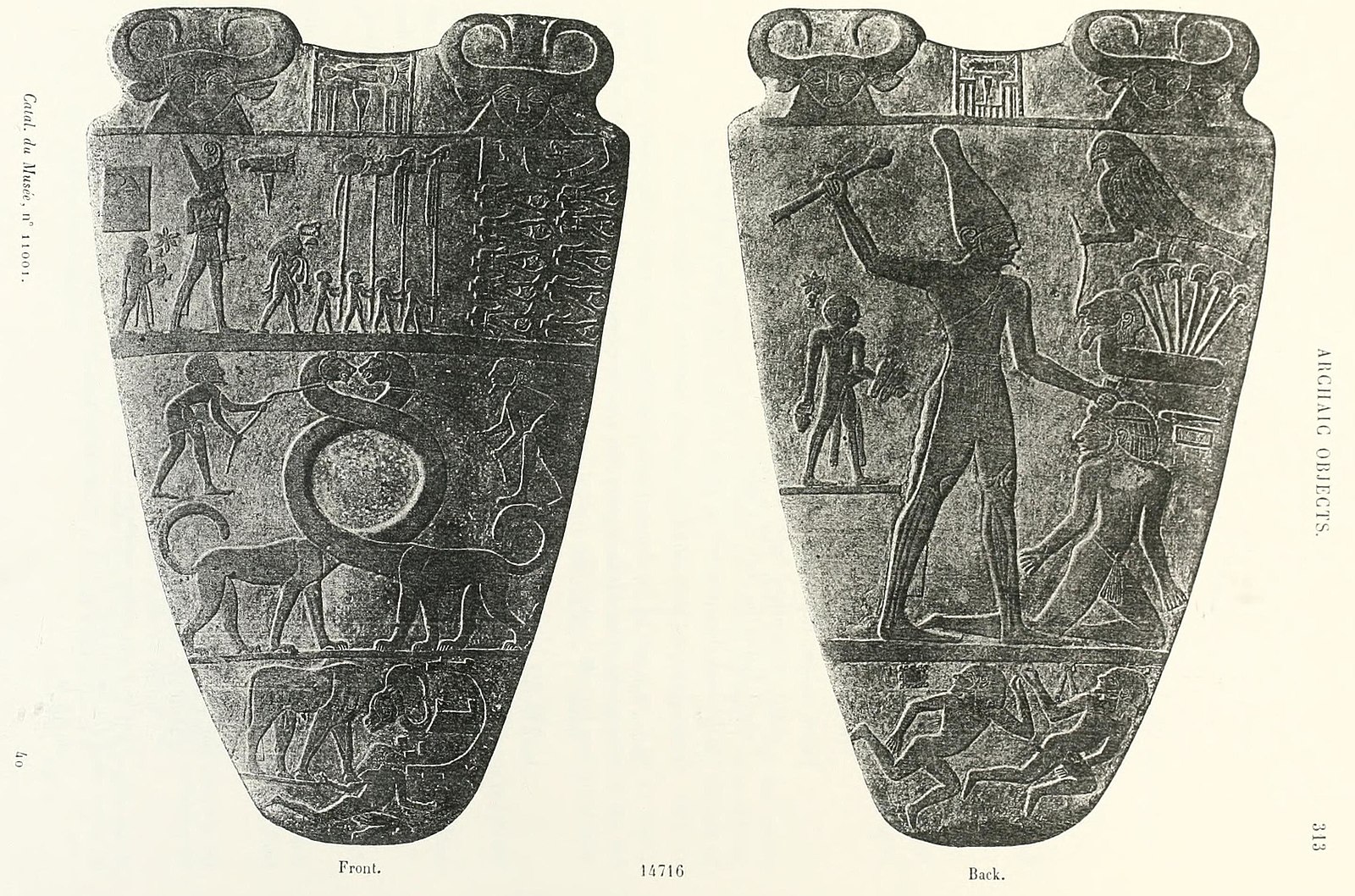
Egypt was one of the first places in the world where advanced cultures began to develop in ancient times. There was a very clear reason for this, one which would facilitate the development of such a long-lasting civilization over several millennia. This was the inundation of the River Nile, a phenomenon which no longer occurs in Egypt owing to the construction of the Aswan Dam in the middle of the twentieth century and the artificial manipulation of the lower course of the River Nile. In ancient times though the Nile flooded every year, leaving a layer of rich alluvial deposits on either side of the river that could then be used as prime farming land. It was this which allowed for the development of a thriving society here in ancient times in the midst of what is otherwise a land dominated by the desert. It also ensured that the Nile became central to the worldview of the ancient Egyptians and we find Osiris, the god of the river, becoming a major deity who offerings were made to each year to try and insure a good inundation of the river and a bounteous harvest. By the middle of the fourth millennium BCE thriving communities had emerged all along the river in what are now Upper and Lower Egypt. Somewhat counter-intuitively, Lower Egypt is actually the northern part of Egypt and Upper Egypt is the southern part of the country towards Sudan, or what the ancient Egyptians termed Nubia. This is because the Egyptians designated these not according to north and south, but the altitude of the land. The north was ‘Lower’ as the Nile moves downhill before draining out into the Delta and then the Mediterranean Sea, whereas the south is more uphill. The ancients viewed Egypt as being comprised of two kingdoms, Upper Egypt and Lower Egypt and the pharaohs are generally depicted on ancient temple facades wearing both the white, cone-shaped crown of Upper Egypt and the flat, red crown of Lower Egypt. It is therefore very significant that the first ruler of ancient Egypt that we know the identity of was King Narmer. Our information on him is very tenuous. Egyptologists believe that he possibly ruled around 3150 BCE. One of the earliest major archaeological discoveries pertaining to ancient Egypt is the Narmer Palette, a stone slab depicting Narmer and beginning to show many elements of ancient Egypt’s distinctive art forms emerging in the late fourth millennium BCE.
Hieroglyphics, Gods and Goddesses
The Narmer Palette is also notable as one of the first examples of a piece of ancient Egyptian material culture which contains hieroglyphics, the ancient Egyptian pictographic system of writing. The development of it in the late fourth millennium BCE was one of several developments between 3500 BCE and 3000 BCE in Egypt that began the process whereby a distinct culture and society emerged here. The writing system does not constitute a consonantal alphabet where letters are arranged in different sequences to form words. Instead pictures were assembled that depicted different ideas or concepts that changed depending on the arrangement of them. This means it is a pictographic writing system, though one which evolved over time. This early system was used to facilitate trade and government activity. It also had a much greater religious purpose than did the cuneiform writing system which developed in Mesopotamia in modern-day Iraq just slightly earlier than the hieroglyphic system in Egypt. That religious system in Egypt would become intrinsic to its society for a period of more than 3,000 years in ancient times. The Egyptians were polytheists, meaning they worshipped a large pantheon of multiple gods and goddesses. Each of these was believed to be a patron of, or ruler over, a specific domain of the world. For instance, we have already seen that Osiris became associated with the River Nile and its annual flood and so was worshipped as the giver of life through a proper inundation and a bounteous harvest. He was also the god of the Egyptian underworld.

Other major deities included Ptah, the god of craftsmen and industry, Isis, a goddess of the underworld and simultaneously the wife and sister of Osiris, and Horus, the son of Osiris and Isis. Seth was the god of war. In the ancient Egyptian mythological system, the most famous story was the Osiris myth, part of which involved Seth trying to displace his brother Osiris as the ruler of the underworld. Still, the Egyptians worshipped Seth as a god of war and they did not have an exclusionary religious system of good and evil where certain deities were benevolent and some were malign. Finally, the foremost Egyptian deity early on was Ra, the Sun god, who in their system was said to travel across the sky each day in a celestial solar arc, bringing light to the world before resting at night. This religious system had a very strong focus on death and the afterlife, a factor which would in part explain the monumental tomb-building of the Egyptians over thousands of years.
The Old Kingdom

Narmer’s ascent as the ruler of both Upper and Lower Egypt marked a distinct shift in the early history of ancient Egypt. With this the Early Dynastic Period began, one which involved the so-called First and Second Dynasties of Egyptian history. There would be 32 dynasties in all down to the end of the Ptolemaic Dynasty, the Thirty-Second Dynasty, in 30 BCE. While the Early Dynastic Period was a formative stage in the kingdom’s history, the first great period of ancient Egypt was the Old Kingdom. This began around 2700 BCE with the rise of the Third Dynasty and would last down to around 2200 BCE. It was characterised by a more powerful central government that ruled Upper and Lower Egypt from Memphis, the ancient capital that stood just to the south of modern-day Cairo. It was the first of the three ‘golden ages’ of ancient Egyptian history, the others being the Middle Kingdom and the New Kingdom. The rulers of the kingdom throughout these periods were known as the Pharaohs. The term seems to have evolved from words meaning ‘great house’. It only appears to have entered widespread use around the middle of the second millennium BCE to describe both the kings and queens of Egypt. However, Egyptologists use it retroactively to describe the rulers of Egypt going all the way back to Narmer.
Pyramid-Builders
One of the things which marks the Old Kingdom as profoundly distinct from the Proto-Dynastic and Early Dynastic periods that preceded it was that the pharaohs of the Third Dynasty, the first dynasty of the Old Kingdom, began building pyramids as burial tombs for the pharaohs. At its most basic a pyramid is a giant heap of stones stacked up on top of one another in a pyramid shape. What mark these as distinctive are their sheer size and the sophistication of the building methods. From around 2670 BCE the Egyptians began building pyramids which utilised millions of tons of stone. The first pyramid to have been built was the Step Pyramid at Saqqara northwest of Memphis.

It was built as the tomb of the Pharaoh Djoser and looks somewhat unsophisticated in terms of its layered or ‘stepped’ construction. More sophisticated models were soon being built as Egyptian pyramid-builders learned quickly through trial and error. An absolutely vital figure in this respect was Pharaoh Sneferu, who ruled for several decades in the late twenty-seventh and early twenty-sixth centuries BCE. He built three different pyramids: the Meidum Pyramid, the Bent Pyramid and the Red Pyramid. The Bent Pyramid, which has a notable bend in its curvature half way up the sides, is noteworthy as being one of the only ancient pyramids in which the smooth limestone casing that covered all pyramids in ancient times is substantially still intact to this day. However, the Red Pyramid, so-called owing to the reddish hue of the inner blocks of stone, was the greatest of Sneferu’s pyramid. It is the first ‘true’ pyramid to have been built, meaning its sides were in geometric proportion and it is a proper mathematical pyramid.
Khufu and his Great Pyramid
While there were dozens of pyramids built during the Old Kingdom era, one in particular merits especial attention. This is the Great Pyramid of Giza, built on the Giza Plateau and overlooking the city of Cairo today.

It was constructed as the tomb of Pharaoh Khufu, otherwise known as Cheops in the ancient Greek rendering of his name and the one that was preferred by scholars instead of Khufu for many centuries. Khufu was born around 2630 BCE, though the King Lists which we use to establish the roll-call of Egyptian pharaohs are contradictory for the Fourth Dynasty and he may have been born as early as 2640 BCE or as late as 2620 BCE. He succeeded his father Sneferu as Pharaoh sometime around 2600 BCE or thereafter. Unlike his predecessors, Khufu did not begin building a monumental tomb to be his resting place at Saqqara, instead deciding on a new site at Giza. He was also an innovator in his ambitions. He would build the greatest pyramid ever constructed. How exactly the Great Pyramid was built has perplexed historians and Egyptologists for centuries. The core of it consists of approximately 2.3 million stone blocks that are over a metre long and weigh around 2.5 tons each. Thus, six million tons of stone had to be quarried to build the Great Pyramid. Although most of this was quarried nearby, it still required an enormous amount of manpower to quarry it, cut it, move it and then stack it up into the 216 layers of stone that make up the pyramid. How the blocks were even put into place has bewildered analysts, with some claiming that a ramp to slowly pull the stones upwards to the higher levels would have had to have been an enormous engineering feat in and of itself just to stop it from collapsing under the weight of the stones. Even ancient writers like the Greek historian and anthropologist, Herodotus, or the third century BCE Egyptian priest and scholar, Manetho, expressed bewilderment at the feat and argued that Khufu was a hated figure for enslaving tens of thousands of men in order to make them work on his tomb for decades. Little wonder that some have even claimed that the Great Pyramid, which is an astrological marvel as well in terms of how its sides and passages align with certain star constellations, must have been built by some long-lost civilization. But the evidence is there for how it was built. Tens of thousands of workers were involved in it. They were not, though, slaves. Instead they seem to have been skilled workmen who on the basis of archaeological investigations of the workers’ towns near Giza were very well fed and looked after. They used water technology to hugely accelerate the quarrying and cutting of the stone blocks and a study published in 2024 has now revealed for the first time that an islet of the River Nile which has since dried up once ran to the Giza Plateau. This would have made transport of the blocks to the building site far more feasible. The result, probably after about 25 years of construction, was the greatest of the pyramids. It would have looked different to how it does today. Polished stone was used to produce a spectacular casing on the outside of it. This had been lost over the centuries though owing to both human action and earthquakes in the vicinity of Cairo. Such was the success of the project that Khufu’s son, Khafre built a pyramid alongside his father’s at Giza. It is the second largest one, just slightly smaller than the Great Pyramid, while the third of the trio was built as the tomb of Menkaure, Khafre’s son, though it is considerably smaller.

Egyptologists believe that the Sphinx, the giant statue of a lion with a man’s head, was erected by Khafre. Unfortunately, information on the wonders that might have been contained in the tombs within the pyramids is entirely speculative. They were robbed as early as the First Intermediate Period.
The First Intermediate Period
Although the Old Kingdom was perhaps at its peak in the era of the Third and Fourth Dynasties as the pyramids were being built at Saqqara, Giza and elsewhere, it continued for centuries thereafter, that is until the early part of the twenty-second century BCE. Around 2180 BCE the Sixth Dynasty came to an end. A period of immense disorder followed over the next century and a half. Crucially the kingdom became badly divided, with rival monarchs ruling different parts of the country from two different capitals. These were Heliopolis in the north or Lower Egypt, north of modern-day Cairo and the Old Kingdom capital at Memphis, where the Nile forks outwards into many channels to become the Nile Delta, and Thebes in the south or in Upper Egypt, a city approximate to modern-day Luxor. The removal of political power from Memphis and the fragmentation of it between two different centres in Heliopolis and Thebes was indicative of a splintering of central power in the realm, though it was not really a civil war per say. Instead this was simply a dark age in which the power of the pharaohs collapsed for a time and local elites became broadly independent. It is known as the First Intermediate Period to Egyptologists and lasted down to around 2050 BCE. It was soon followed by a political and social revival in the Middle Kingdom.
The Middle Kingdom
The Middle Kingdom began around 2050 BCE and saw a major revival of central authority amongst the pharaohs of the Eleventh and Twelfth Dynasties. These ruled from Thebes, which now fully replaced northern cities like Memphis and Heliopolis as the centre of political power in Egypt. There were other social shifts. For instance, during the Old Kingdom the Sun god Ra had been the pre-eminent Egyptian deity. In the Middle Kingdom, Amun rose to become the greatest god in the Egyptian pantheon, though eventually a fusion would take place and Amun-Ra would be worshipped by the middle of the second millennium BCE. One thing which is perhaps unusual about this era is that while there was a resumption of pyramid building, the material now used was mud-bricks rather than large stone slabs. This has meant that these pyramids, such as that of Pharaoh Senusret II at El Lahun, have not survived intact down to the present day. The bricks have eroded away gradually as a result of weather erosion and other factors, though there are still often large sections of the core of these pyramids still standing. Beyond this, the Middle Kingdom is distinctive for the manner in which a sophisticated form of sculpture emerged, while there are many papyrus books extant from the period between 2000 BCE and 1750 BCE which contain medical manuals and mathematical and astronomical treatises. These highlight how the Egyptians were making important breakthroughs in many scientific fields at a time when the Babylonians were doing the same thing in Mesopotamia.
The Second Intermediate Period
The Middle Kingdom came to an end around 1700 BCE, though we might call the Second Intermediate Period that followed it something of a brief interlude. This Second Intermediate Period lasted for about a century and a half. It is distinctive of what came before it and what came afterwards not because Egyptian society entered a period of pronounced decline like happened during the First Intermediate Period, but rather because of the incursion of a foreign power which for a time controlled much of Egypt. These are known as the Hyksos. Their origins remain unclear to this day. Most scholars agree that they hailed from somewhere in the Levant, possibly from around Canaan or further to the north in Phoenicia or Syria. What’s clear is that in the half century or so between 1700 BCE and 1650 BCE they established themselves as a major force in Egypt from the city of Avaris on the eastern side of the Nile Delta. They controlled much of Egypt from here over the next century down to 1550 BCE. Perhaps they were Canaanites who aggressively incurred into northern Egypt and began conquering lands, though other Egyptologists argue they were simply settlers who established themselves in Avaris in large numbers and then began to grow in power as the central government’s authority in Thebes declined in the seventeenth century BCE. Whatever the exact nature of it, the Hyksos became a major foreign power in the region for over a century. This is the dominant characteristic of the Second Intermediate Period.
The New Kingdom

The Second Intermediate Period was quickly followed by an era in which ancient Egypt reached the pinnacle of its power. This is known as the New Kingdom and lasted from around 1550 BCE down to 1077 BCE when the Ramessid Dynasties came to an end. This being said, most historians and Egyptologists agree that the peak of the New Kingdom came between 1500 BCE and 1200 BCE. There were three dynasties during the New Kingdom, the Eighteenth, Nineteenth and Twentieth Dynasties. The Nineteenth and Twentieth are often categorised together though as the Ramesside Period, as there were no less than eleven Pharaohs named Ramesses during this era virtually one after another, the greatest of course being Ramesses II. The New Kingdom would not see any major pyramid-building and in some senses that could be said to mark a regression from the Old and Middle Kingdoms. Yet this was more than compensated for in other respects. It is, for instance, to the New Kingdom period that most of the great temples of ancient Egypt, such as the Temple of Karnak at Luxor and the Temple of Abu Simbel at Aswan, date.

This was also an age in which the Egyptian kingdom became a great power. A well-run centralised government was able to raise taxes, assemble large armies and extended its territory into the Western Desert towards Libya, south up the course of the Nile to Nubia and even well into the Levant. Trade flourished in tandem around the Eastern Mediterranean and the sense is of a prosperous people in Egypt between the fifteenth and thirteenth centuries BCE. A number of pharaohs also stand out from this era.
Thutmose and the New Kingdom Empire

Arguably the greatest of all of Egypt’s pharaohs is one few people today have heard of. Most people will know the names of Ramesses II, Tutankhamun and Nefertiti, each of whom we will hear more about presently. Far fewer people have heard of Thutmose III. He ascended as Pharaoh when he was little more than an infant in 1479 BCE. His reign would last over half a century to about 1425 BCE. Again the dates are not 100% clear as the extant King Lists from ancient Egypt offer contradictory dates. During the early stages of his reign another individual from ancient Egypt whose name people will be familiar with ruled as regent for the boy king. This was his stepmother and aunt, Hatshepsut. Many developments occurred during Thutmose’s reign. For instance, he expended enormous energies and resources on the development of the Temple of Karnak at Thebes, the great temple complex which still stands substantially intact in the modern-day city of Luxor today. Thutmose though is primarily known as a warrior king. He launched over a dozen military campaigns during his reign into the Levant, fighting various powers there such as the Canaanites, the Mitanni and the Assyrians. His primary antagonist was the Hittite Empire, a powerful state which had emerged to rule what are now Turkey and some other adjoining lands in Syria and the Lebanon from their capital at Hattusa. Thutmose defeated a broad coalition led by the Canaanites and Mitanni at the Battle of Megiddo in 1457 BCE before then waging war on the Hittites on several occasions. As a consequence he was able to extent the Egyptian New Kingdom to the greatest limits of the Egyptian state seen in ancient times, with much of the Levant coming under Egyptian control as Thutmose made good use of the technology of chariot warfare that had earlier been introduced into Egypt by the Hyksos. The conquest of parts of the Levant was particularly important as the coastal trading cities here like Tyre and Sidon were wealthy ports during the Bronze Age.
Heresy: Akhenaten and the Sun Disk

.jpg)
daughters under the rays of Aton
The New Kingdom continued to prosper for several hundred years after Thutmose. It faced a remarkably peculiar crisis in the middle of the fourteenth century BCE though. Around 1350 BCE a Pharaoh by the name of Amenhotep IV succeeded to the throne. He is much more widely known by the name he adopted during his reign: Akhenaten. This transliterates as ‘Effective for the Aten’. What was this ‘Aten’? Aten was a relatively minor Egyptian solar deity, a Sun god worshipped as a Sun disk. Worship of Aten had been peripheral to the Egyptian religious-mythological system for centuries. Now, just a few years into his reign, Akhenaten changed his name and began implementing a series of measures designed to effectively establish Aten as the pre-eminent deity in Egypt. Egyptologists differ on whether this should be categorised as an early experiment in monotheism, the worship of one god, or a form of monolatry, wherein a pantheon of multiple gods are acknowledged but one is worshipped above all the others. There were monolatristic elements to Egyptian religion with centuries, specifically in the worship of Ra during the Old Kingdom, the pre-eminence of Amun-Ra during the New Kingdom era, and the worship of Osiris and Isis many centuries later in the first millennium BCE. Still, what Akhenaten was undertaking was considered highly peculiar. He even began building a new capital at Amarna hundreds of kilometres north of Thebes, profoundly alienating the old priestly caste of the traditional capital in the process. Here a quasi-outdoor great temple was built to allow the Sun disk to be viewed and worshipped as it rose and fell each day. There is also a distinct shift in the art of the era, with statues of Akhenaten and other members of the royal family such as his famous wife, Nefertiti, having a peculiarly thin and angular, almost feline, shape to their faces. Clearly these changes constituted a religious revolution, though what Akhenaten’s motives might have been in undertaking them remains speculative. Many people who were disconcerted by this course of events would have been happy when he died prematurely around 1335 BCE, possibly as part of a serious plague pandemic which struck Egypt at that time.
Tutankhamun and the Valley of the Kings

Egyptian Museum of Cairo.
There was a rapid turnover of pharaohs in the immediate aftermath of Akhenaten’s death around 1335 BCE. We cannot be sure of the identity of the rulers involved. What’s clear is that out of the chaos, Tutankhamun, seemingly a son of Akhenaten who was still only about nine years old at the time, ascended as Pharaoh around 1332 BCE. He would not have been responsible for the initiation of the policy that followed. Whoever the regents that ran affairs while he was still a child would have been. These individuals, the identities of which are not clear, began an aggressive campaign to stamp out the heresy which Akhenaten had initiated. They had the city of Amarna systematically dismantled and restored Thebes as the capital. Then they had officials traverse the country far and wide defacing icons that had been set up to the Sun disk, Aten, and restoring the old gods. There even seems to have been a systematic effort to erase the memory of what Akhenaten had done by destroying written records and removing inscriptions from temples and other public buildings. Hence Tutankhamun’s reign was significant in a sense, though he himself died around 1323 BCE when he was just around 18, possibly from a hereditary illness. He is extremely well-known today for such a minor Pharaoh, a development which is entirely owing to the fact that when the Egyptologist, Howard Carter, uncovered his tomb in the Valley of the Kings, the vast valley of royal tombs in the mountains to the west of Thebes, in 1922, he found the tomb intact. Unlike nearly all Egyptian royal tombs it had not been robbed of its grave goods and so the rich gold objects and other valuables that Tutankhamun had been buried with were still there, most famously his fabulous gold death mask. It is, after the pyramids and the Sphinx at Giza, the most iconic symbol of ancient Egypt.
The Greatest Pharaoh: Ramesses II


Just slightly less than half a century after Tutankhamun’s time arguably the most famous Pharaoh of them all rose to the throne. Ramesses II was the third king of the Nineteenth Dynasty, his grandfather, Ramesses I, having come to the throne after serving as Vizier, a kind of prime minister, to Pharaoh Horemheb, the last ruler of the Eighteenth Dynasty. Ramesses II is understood to have ruled for a period of over sixty-five years between 1279 BCE and 1213 BCE. His reign was marked by several great initiatives and events. Abroad he expanded the New Kingdom and waged war on the Hittite Empire, acquiring new territory in the Levant amongst the Canaanites and other groups in what are now northern Israel, the Lebanon and Syria. These efforts led to the Battle of Kadesh in 1274 BCE with the Hittites around the modern-day border between Lebanon and Syria. It is believed to have potentially been the largest battle involving chariot warfare in history, with thousands of the ancient battle vehicles being deployed. We know a lot about it because it is one of the best documented battles in all of ancient history, Ramesses having the details of it immortalised in inscriptions set up in the Levant and on the walls of many temples and other civic buildings in Egypt in the years that followed. Despite his propaganda efforts, the battle actually ended in something of a stalemate. Still, it did see the Hittites acknowledge the Egyptians in their control of the southern Levant, which, along with successful campaigns by Ramesses in places like the Western Desert, Nubia and eastwards across the Sinai Peninsula to northern Arabia left Egypt in as strong a position militarily and territorially than it would ever stand in. Given the length of his reign, these military campaigns and the subjugation of foreign people which they entailed, perhaps it is unsurprising that many scholars hold that Ramesses was quite possibly the Pharaoh of the Book of Exodus in the Old Testament and the Tanakh, meaning that the Israelites were a subject people of the Egyptians at the height of the New Kingdom. Beyond this military expansion, Ramesses was a great builder and constructed some of the foremost temples built in Egypt such as the Ramesseum on the western bank of the River Nile across from the city of Thebes and the Temple of Abu Simbel in southern Egypt, with its iconic four colossal 20-metre high statues of Ramesses and the gods. Finally, he moved the administrative centre of the kingdom to Pi-Ramesses, a new city which he built near Avaris on the eastern side of the Nile Delta in order to be closer to the Levant which he was trying to more fully incorporate into his empire.
The Late Bronze Age Collapse
The long reign of Ramesses II might have been one of the peaks of ancient Egypt’s civilization, but it was followed by a very swift decline. Already in the thirteenth century BCE there were major signs across the world of the Eastern Mediterranean that all was not well. The Minoan Civilization on the island of Crete had been virtually wiped out by a major earthquake there sometime around the sixteenth century BCE. This was followed by a series of escalating incursions into the kingdoms and empires of the region by mysterious foreign invaders. The most significant of these were the mysterious ‘Sea People’. Archaeologists and historians of the ancient world still debate where they came from. What we do know is that in the fourteenth, thirteenth and twelfth centuries BCE groups like these devastated the ancient world. They destroyed the Hittite Empire and several other powers and they enormously weakened Egypt through raids on the north of the country. Long distance trade collapsed and the Bronze Age kingdoms across the region declined, processes which were probably compounded by shifting weather patterns that led to crop failures. The overall result was a marked decline in the culture of the region, so much so that a ‘Late Bronze Age Collapse’ between 1350 BCE and 1150 BCE is now an accepted fact of the history of the ancient world. Egypt survived, unlike the Hittite Empire, but the New Kingdom now gave way to the Third Intermediate Period.
The Third Intermediate Period
The Third Intermediate Period is usually identified as having begun following the death of Ramesses XI, the last of the Ramessid pharaohs, in 1077 BCE, though by then Egypt had long declined from the heights of the glory days of Thutmose III and Ramesses II. The Third Intermediate Period would last for four centuries, down to 744 BCE when a new Nubian Dynasty emerged from the southern climes of ancient Egypt in what we would now broadly call Sudan to rule over a rejuvenated and reunited kingdom, though there is a dispute as to what the Third Intermediate Period even entails. Some Egyptologists, for instance, include the Nubian Dynasty as part of it, though there are strong arguments against this categorisation. This era saw four main dynasties, the Twenty-First, Twenty-Second, Twenty-Third and Twenty-Fourth Dynasties. Power fragmented during the rule of these pharaohs, with the capital moving around frequently between the cities of Tanis, Bubastis, Heracleopis Magna and Sais, while at times there were competing rulers who controlled different parts of Upper and Lower Egypt from different capitals. We do still find monumental tomb-building occurring and fabulous funerary objects were recovered from the tombs of Psusennes I and Shoshenq II, pharaohs of the late eleventh and early ninth centuries BCE when they were found un-looted in 1939. These included a golden death mask of Psusennes I which is nearly as spectacular as that of Tutankhamun yet which for some strange reason is not as well-known about today.
The Nubian Dynasty
The Third Intermediate Period ended in the middle of the eight century BCE with the assent of the Nubian Dynasty, the Twenty-Fifth Dynasty of ancient Egyptian history. Nubia, as we have seen, was the name for the land far to the south of Egypt proper in what we would now term Sudan. Still, Nubia had been ruled as part of the New Kingdom empire and at other times in Egyptian history. The dynasty was founded by Pharaoh Piye, who ruled from 744 BCE to 714 BCE, a lengthy period in which he united Upper and Lower Egypt under his rule.
![Drawing of the upper-right part of the victory stele of pharaoh Piye, depicting Piye being tributed by four Nile Delta rulers: Nimlot (holding an horse) and his queen (before him), Osorkon IV, Iuput II and Peftjauawybast [see note for details]. Original stele in granite, found at Jebel Barkal and datable to the reign of Piye, 25th dynasty, now in the Cairo Museum.](https://i0.wp.com/culturepassport.uk/wp-content/uploads/2025/09/Stele_Piye_submission_Mariette.jpg?resize=1024%2C682&ssl=1)
He was arguably the strongest ruler seen in ancient Egypt in centuries and also engaged in monumental building at Jebel Barkal, a messa in northern Sudan which is a UNESCO World Heritage site today. The Nubians, it is often overlooked, were also great pyramid builders. Indeed, there are the remains, whether partial or largely intact, of approximately 250 pyramids in Nubia today, almost twice the number that are in Egypt itself. Some of these were built during the period of the Nubian Dynasty, although the greatest of the Nubian pyramids were built at the city of Meroe many centuries later. What is significant was that the Nubian Dynasty led to the transplantation of these Egyptian cultural practices into Sudan roughly between 750 BCE and 650 BCE, a process which would have an impact down to the third century CE.
Assyrians, Babylonians and Persians
The Nubian Dynasty could technically be viewed as a foreign dynasty ruling over ancient Egypt, though we should be wary of viewing the Nubians and Egyptians as distinct simply in light of the modern-day border between Egypt and Sudan, a distinction no ancient Egyptian would have made. Nevertheless, the Nubian Dynasty did open up a period of foreign rule in Egypt which would last to some extent for the remainder of its ancient history. Despite this foreign domination, most Egyptologists agree that ancient Egypt’s history only terminated in 30 BCE either because these foreign interventions were short-lived and had little impact on the local culture or because the invaders actually ended up adopting much of the culture of the Egyptians, effectively being culturally absorbed by the subject people. There was a very swift turnover of powers in this regard. First came the Neo-Assyrians from northern Mesopotamia in the middle of the seventh century BCE under their great ruler Ashurbanipal. He ordered several military campaigns into Egypt during his reign between 669 BCE and 631 BCE, but these only ever established a fleeting Assyrian control over the land of the Nile. In any event, the Neo-Assyrians were soon superseded as the dominant power in the Mesopotamia region by the Neo-Babylonians. Their foremost ruler, Nebuchadnezzar II, attempted to conquer Egypt too in the early sixth century BCE. It was the Persian Achaemenid Empire, which rose swiftly to conquer most of the northern parts of the Middle East from the 550s BCE onwards, that finally established a more firm foreign domination over Egypt. In 525 BCE the Persian ruler, Cambyses II, launched a major military campaign into Egypt, one which quickly brought the country under Persian domination. A satrap, or local vassal ruler, was put in place to rule the region on behalf of Cambyses and his successor. Still, even this arrangement was malleable. One of the local rulers, Amyrtaeus, rebelled against Persian rule in 404 BCE and managed to establish the country’s independence again for several decades, though a Persian re-conquest a half a century later around 340 BCE points to how fluid the situation between the sixth and fourth centuries BCE was.
Alexander the Great and Ptolemaic Egypt


The second period of Persian rule in Egypt would be very short indeed. Less than a decade after a Persian satrap was reinstalled in the land of the Nile, the Macedonian ruler, Alexander III, better known to posterity as Alexander the Great, began his invasion of the Persian Empire. Between 334 BCE and 329 BCE his Greek and Macedonian phalanxes conquered the entirety of that empire and then marched further eastwards to the edge of the known world at that time in India. When he diverted to Egypt in 331 BCE the local elites there hardly offered any resistance. They were, after all, simply swapping one foreign ruler for another. In the aftermath of Alexander’s death in 323 BCE his empire fragmented and a series of civil wars which lasted four decades began amongst his leading generals and allies to claim power. Eventually, one of these generals, Ptolemy, established control over Egypt. The Ptolemaic Dynasty which he founded would control the country for three centuries until Cleopatra’s demise in 30 BCE. Undoubtedly this should be considered to have been a foreign dynasty ruling over Egypt. Nevertheless, at the same time, the Ptolemies absorbed a great deal of ancient Egyptian culture and ‘went native’ as it were to a considerable extent. One need only look at painting reliefs of the royal family between the third and first centuries BCE to realise that while they might have been Macedonian in origin, this dynasty had most certainly acclimatised to Egypt by adhering to many of the cultural tropes found here. Scholars consequently consider the Ptolemaic era the last episode in the history of ancient Egypt.
The Greatest City in the World: Alexandria
The Ptolemaic era is very notable in the history of ancient Egypt for the emergence of the city of Alexandria as the greatest city in the world for a time. This had been founded by Alexander the Great on the western side of the River Nile Delta during his brief period in North Africa in 331 BCE. Unlike some of the other almost two-dozen cities, all called Alexandria, that the Macedonian ruler founded during his campaigns, Alexandria in Egypt grew very quickly and became the capital of the Ptolemaic kingdom. It also flourished during the third century BCE as the world’s new centre of learning, as the centre of gravity in that regard moved from Athens to Alexandria. This was under the patronage of the first four Ptolemaic rulers, each of whom was enlightened, though amongst which Ptolemy II Philadelphus, who ruled from 285 BCE to 246 BCE, stands out. It was Philadelphus who sponsored the development of a great library in the Mouseion district of temples and civic buildings in the heart of the city. This became the greatest repository of knowledge in the ancient world. Alexandria drew scholars from all around the Eastern Mediterranean as a result. Two notable ones early on were Euclid and Eratosthenes, two geographers and mathematicians of the third century BCE who transformed ancient understanding of geometry, algebra, geography and many other scientific fields. For instance, Eratosthenes calculated the circumference of the world with fairly remarkable precision given the limited tools and information available to him with which to do so. It was also at this time that Manetho, a native Egyptian priest, composed a series of works on Egyptian history such as the Aegyptica which are extremely valuable for reconstructing the history of ancient Egypt. Alexandria would continue to hold its position as the pre-eminent centre of scientific knowledge and study in the world down to the fourth century CE. Some of the discoveries made here would dominate many scientific fields of inquiry down to as late as the eighteenth century.
Roman Expansion and the End of Ancient Egypt
Even as Alexandria was emerging as one of the greatest cities the pre-modern world had ever seen, a city of unprecedented learning and scientific exploration, a new power was rising that would conquer Egypt and bring its ancient civilization to an end. Few great powers had come from the Western Mediterranean in ancient times. The centre of military and political power had always lain in the Eastern Mediterranean. Therefore the relatively rapid ascent of the Roman Republic as a major power there in the third century BCE, one which began interfering in the Hellenistic world of the Eastern Mediterranean in the second century BCE, was something of a surprise to ancient people. By the year 100 BCE the Romans had conquered mainland Greece and were expanding into parts of Anatolia and Asia Minor in modern-day Turkey. They were facing stiff opposition from two Hellenistic powers, the Kingdom of Pontus on the northern side of Turkey along the Black Sea coast and the Seleucid Empire. The Ptolemaic Dynasty in Alexandria hewed a different path. They adopted a more accommodating stance towards the Romans, essentially becoming a vassal state or client kingdom of the Romans. They maintained their independence to some extent, yet when it came to their foreign policy they were subservient to the Romans. This approach allowed the Ptolemies to survive for over three decades longer than the Kingdom of Pontus and the Seleucid Empire, both of which were finally conquered by the Roman general, Pompeius Magnus, in quick succession in the late 60s BCE. The final undoing of Ptolemaic Egypt was when Cleopatra decided to support Mark Antony in the civil war that developed across the Roman world between him and Octavian. When Antony lost the war, Egypt lost its independence. It was transformed thereafter into a Roman province, one which served as a major breadbasket of Rome. Alexandria would remain one of the largest cities in the entire empire for centuries to come, second only to Rome. It also remained the centre of scientific learning. It passed as such to the Eastern Roman Empire or Byzantine Empire from the late fourth century CE onwards. The greatest transformation experienced by Egypt came in the seventh century CE when it was conquered by the Arabs during their series of massive conquests of the Middle East, Maghreb and Central Asia. With this, an entirely new culture and society, one centred on Islam and Arab cultural mores, developed here.
Legacies
The legacy of Ancient Egypt was very great indeed. One could not visit Egypt over the centuries and view the marvels of the Great Pyramids on the Giza Plateau and the Sphinx standing watch over them, or the pyramids at Saqqara, and the great temples of Karnak and Abu Simbel, without wondering about the people who had built them in the ancient past. They were especially intriguing because over the centuries people lost the ability to read the hieroglyphic writing on the walls of these temples. What did this strange script say and what might it reveal about the people who had built such enormous monuments, many a European traveller to Egypt wondered in the sixteenth, seventeenth and eighteenth centuries? In 1798 Napoleon Bonaparte’s expedition to Egypt to conquer the country from the Ottoman Empire and use it as a staging base to attack British India offered an opportunity to answer these questions. A team of French scholars was despatched to Egypt with Bonaparte’s army. It was these individuals who established the discipline of Egyptology, largely through the discovery of the Rosetta Stone, a stele or stone slab found in Egypt which contained a decree issued by Ptolemy V written in both ancient Greek and hieroglyphics. Using this, the French scholar, Jean-Francois Champollion, was able to decipher the hieroglyphic writing system. Thus began the process whereby texts from all over Egypt were translated and the history of the ancient civilization that existed there for over 3,000 years started to rematerialize. Today Egyptology is one of the foremost fields of archaeological inquiry and the country’s tourism sector, much of which is driven by interest in its ancient past, accounts for over 10% of the country’s economic activity. Thus, over six millennia after Narmer emerged as the first king of the lands of the River Nile, the civilization that existed there in ancient times continues to have a tangible impact.
Leave a Reply