Imagine if ISIS suddenly became democratic. Or if the US became gun-free. Or if Italy shunned the Catholic Church and ransacked Vatican City. These possibilities seem farfetched and alien, yet there are some historical precedents.
The ancient Egyptian pharaoh Akhenaten of the 18th Dynasty upended the foundations of Egyptian culture, religion, and arts. His successors vilified his actions to the point that historians didn’t know of his existence for the longest time. His statues were thrashed, his capital city was dismantled, and its construction remains were carried off to other sites. Subsequent kings made sure to erase him from history in any way deemed possible. But history did not yield. This is the tale of that forgotten emperor and his revolution. This is the tale of Akhenaten—the heretic king.
Ancient Egyptian art remained notoriously stale for multiple millennia. Check out below different pharaohs’ sculptures. Sometimes artists didn’t even bother to sculpt a fresh statue for a newly anointed pharaoh; they’d refashion an existing sculpture of an older king.


No wonder this culture didn’t produce Michelangelo—because, you know, he’d go rummaging for the perfect stone. Anyway, the first thing you’ll see in Akhenaten’s statues (below the Gempaaten colossi) is that he is not depicted in the idealized manner of other Egyptian kings. A far cry from the clichéd image of a well-built muscular emperor who carries himself with authority, he is feeble and ungainly. Thin, long face, bulging belly, and rounded hips—the figure has an overall contorted look. Another critical aspect is the androgynous look, combining the sharp lines of the familiar male figure and the curvature of the stereotypical female figure. Scholars mostly agree that it is a life-like statue: the pharaoh is himself. Usually, kings couldn’t afford to be seen as normal human beings. They were closer to the gods—if not the gods themselves.

Art—like pretty much everything else in Egyptian society, was tied with religion. As Italy’s identity is linked with Catholicism and Middle East’s with Islam, Egypt was married to its brand of polytheistic beliefs and rituals. The pantheon of gods was multi-faceted and diverse. Pharaohs were associated with deities, so deities were mostly anthropomorphic or zoomorphic. Looking at royal carvings, one finds several gods overseeing the kings. Here are a few gods symbolized as animals – Horus on the Khafre statue and Horus and Hathor on the Narmer Palette.


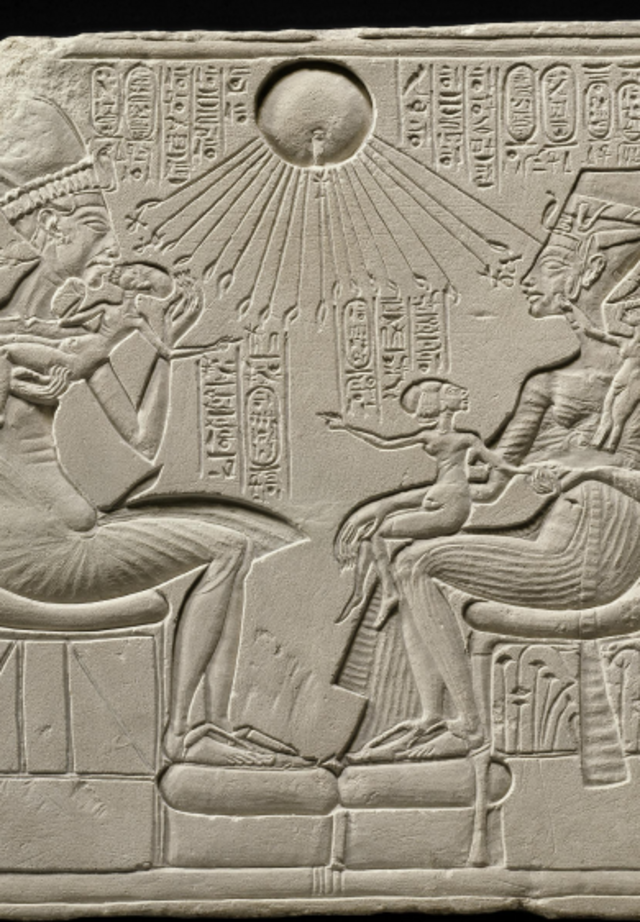
Other gods were represented as humans. Now, take a look at some art from Akhenaten’s rule (reliefs with the sun disk). Yup, only one god—a sun disk.

The domestic gods were often different from the supreme deities. Ra, Amun, Atum, Ptah, Anubis, Bastet, and others were venerated in different epochs. But, the crucial detail to note is that the Egyptian creation myth often revolved around the sun—pardon the pun. Whether it be Amun, Atum, or Amun-Ra, the supreme deity was associated with the solar god or the solar child. Then, there are the mythical rulers of Egypt who were later deified—Osiris, Horus, and Set. While customs and beliefs changed over time, the fundamental elements of the pantheon endured—until, of course, Akhenaten took them to the cleaners.
Akhenaten belonged to the 18th Dynasty, which was the New Kingdom period. At this point, the priests and, specifically, the cult of Amun had gained much ground. Priests oversaw and influenced scribes, artisans, and other important figures. Akhenaten’s predecessor, Amenhotep III, recognized their increasing social leverage and tried to divert the state’s resources toward the worship of Aten. Now, Aten wasn’t a new god; the deity can be traced to at least as far as the Middle Kingdom, but it did not have the stature of Amun or Amun-Ra. When Akhenaten, originally known as Amenhotep IV, rose to the throne, he erected statues in honor of Amun. He made additions to the Karnak temple, the principal religious center of the deity, and honored various cults, including the cults of Amun and Aten.
In the second or third year of his reign, he had a sudden change of heart. He became a fanatic admirer of Aten, the sun-disk thingy. Did the decision have any spiritual impetus? Was there a political vendetta? God only knows—or sun-disk, more like. Amenhotep IV changed his name to Akhenaten—“the Spirit of Aten,” outlawing the cult of Amun and shutting their temples. The new king enforced the worship of Aten with him and his wife, Nefertiti, serving as the only intermediaries—bye-bye, priests! In the fifth year, he declared Aten the official state deity. With the non-zoomorphic, dehumanized Aten becoming the source of all things and establishing a clear hierarchy, the pharaoh established a form of early monotheism.

All cults, except the one, were through. To solidify the status of the one true religion, Amenhotep IV abandoned Thebes and set out to develop a new city. A city that cherished the glory of Aten, Akhetaten—“the Horizon of Aten.” Between Memphis and Thebes, the city of Akhetaten, known in modern terminology as Amarna, grew into a sprawling city on the east bank of the Nile.
You’ll notice in these inscriptions and relief carvings that his wife and children are drawn in equal size as him. In Egyptian art, the male ruler usually occupies the most significant position. Archaeologists often identify the emperor through the established scale hierarchy. But, Akhenaten had his artists depict his wife and children alongside him with equal merit. On the outskirts of Akhetaten, he erected at least four temples dedicated to the royal women. He would retreat there to regenerate his bond with the sun god. The arrival of new artistic ideas ushered in the anomalous Amarna style that continues to baffle and fascinate Egyptologists in equal measure.

Some people claim that Akhenaten’s diatribe against patriarchy may have something to do with the androgynous nature of the art, but that’s conjecture. There are also several theses surrounding the sexual orientation of the notorious king. Researchers speculate that Amenhotep IV could have been queer. Some illustrations show two lovers kissing each other; what makes this genre of pictures an outlier is the fact that the two figures are an almost mirror image of each other. Most people come away from these drawings thinking Akhenaten was an openly gay pharaoh. This shouldn’t be shocking since Egyptian culture did not have the same connotations toward same-sex relationships as the Judeo-Christian tradition. For instance, an Egyptian folktale, King Neferkare and General Sasenet, dealt with what are assumed to be homosexual themes. Akhenaten’s homosexuality could explain the novel and the sometimes androgynous nature of many designs.
In the 12th year of Akhenaten’s reign, Amenhotep III passed away. Soon thereafter, Nefertiti disappeared from the historical records. Here’s a bust of Nefertiti whose color has somehow survived.

Most Egyptian art originally looked like this, brimming with earthy colors, and most surviving colored fragments from the Akhenaten’s palace at Amarna, also known as the North Palace, attest. The relationship of Nefertiti to Amenhotep III, Akhenaten, and the throne is still very much debated. The mirror-image motif that we discussed might depict Akhenaten and Nefertiti. If that’s true, they might have been aligning themselves with Shu and Tefnut, a god and goddess with a shared soul. Shu, the male, signifies preservation, while Tefnut, the female, epitomizes change. Nefertiti might have been a co-ruler with Akhenaten. Whether she was later referred to by a different name, exiled, or passed away is debated. A year or so later, Akhenaten’s mother and one of his sisters died, and three years after that, Akhenaten also met his maker. The most common hypothesis to explain these deaths involves a plague that took over the city of Akhetaten.
Akhenaten ruled for 17 years, and the list of artistic experiments during that period was extensive. For instance, Egyptian monuments were generally built using large stones that required a lot of manpower, tools, and resources—hello, pyramids! But all the construction for the new capital and even the additions to the Karnak Temple were made using small stones that were far easier to move, which is why later pharaohs ransacked his city to steal building materials. The small stone blocks called talatat showed scenes from daily life instead of ritualistic tableaux or recounting military triumphs. The pharaoh and his wife can be seen in casual settings, an unprecedented look for an Egyptian king. One of the vital historical records about Akhenaten and his cult of Aten comes from a structural wall at Amarna. It is known as the Great Hymn to the Aten, a sizeable collection of poems written—and most likely, sung—in devotion to Aten. The lyrics attribute Aten with beauty, love, and fatherhood and resemble Psalm 104 [the King James Version].

The freedom in artistic practices and sudden, radical dynamism of socio-political order are readily apparent in the arts and architecture. The open, roofless courtyards of the Amarna period offered a stark contrast to the rigid, labyrinthine Egyptian tombs and temples of the New Kingdom—or pretty much any epoch. At the temple complex at Amarna called Gempaaten, the gift of sunlight flows right in, rendering the benevolence of the sun god ubiquitous. The Great Temple of the Aten, the deity’s main house of worship, was constructed in a similar fashion. Built on an east-west axis, it embodied the sun god’s path and anticipated the sunlight angles.
As we witnessed from the statue of Akhenaten himself, gone are the stilted angles and the squarely cut figures. In the Amarna style, the line—as in the artistic element of drawn lines, moves much more freely, wielding and folding in rhythmic motions. While aesthetics achieved unprecedented vigor and freedom, their defiance did not dispel religious authoritarianism. It was far from over; in fact, the mythological fervor moved to the tombs. The 18th Dynasty private tombs used to have scenes from regular life, but the 17-year stretch of the Amarna period foregoes them for images of religious zealotry. The Tomb of Ramos at Thebes is an excellent example of this abrupt change. Most likely constructed over several years, the initial design of the vizier’s tomb—during his service under Amenhotep III—is quite traditional. But halfway through, it becomes more creative—some might say unhinged.
Since we’re talking about the period’s style, another dichotomy beckons! We know, so far, that the Amarna court employed at least two sculptors. The first sculptor, Bak, was responsible for the Gempaaten colossi. Once Aten became the state’s official deity, his radical experimentation peaked. He is responsible for some of the most out-there works from ancient Egypt. In the latter years of his reign, Amenhotep IV replaced Bak with Thutmose, a sculptor with a more grounded style. The Nefertiti bust that we looked at earlier is his handiwork. But, they were just two figures in a radical deconstruction of Egyptian mythos.
Queen Nefertiti, King Akhenaten, and their royal family graced tomb walls instead of the usual depictions of Horus, Iris, and other gods. A more perfect example of their contrarian spirit could not exist. After Akhenaten passed away, a mysterious king named Smenkhkare ruled briefly. Some Egyptologists believe Smenkhkare to be Nefertiti. Afterward, the throne then went to Akhenaten’s youngest son, Tutankhaten. Amid increasing resistance to the dead emperor’s reformist agendas, Tutankhaten changed his name to Tutankhamun. He distanced himself from his father’s policies and went on to restore historical conventions in religion, culture, and arts. The sun had finally set on the short-lived Amarna Period and its radical philosophies.
Leave a Reply