So you might have seen these huge wonders of the ancient world—they’re called the pyramids. Well, you and a million other people. How the pyramids were constructed is a puzzle that is bound to take you down a rabbit hole. Some people might know a little bit about Ramesses II, the pharaoh associated with Moses’ exodus. Or King Tut, the accursed pharaoh whose tomb is a tinderbox of conspiracy theories. But that’s generally where people’s knowledge of ancient Egypt ends. By fixating a little too much on the puzzles of ancient Egypt, we often ignore its material remains. We forget its art and architecture.
Why is ancient Egypt so endlessly fascinating? The harsh desert slopes, the billowing sand, and the mud-brick structures endow the landscape with a sense of awe and mystery.
Egypt was one of the greatest civilizations of the ancient world. A pioneer in literature, astronomy, mythology, medicine, engineering, and architecture. Scholarly bickering aside, enough of it has survived to make educated guesses about various aspects of its socio-political life. Of the most vital archaeological remnants are its art, pictorial writing, and architecture. And since they continue to absorb and enthrall us, let’s explore some of their major characteristics:
The Mythological Tie-In
The first and most singularly crucial thing to know about ancient Egyptian society is that it was unequal. If you explained the American Dream to a pharaoh, he’d laugh in your face. And then have you executed. An unbiased look at most historical societies would yield a somewhat similar thesis. But in the case of Egypt, this inequality dictated the artistic capabilities and achievements of an entire region and civilization. Ancient Egyptian art was closely tied with politics, and Egyptian politics was closely linked with religion.
The Egyptian royalty not only represented the religious pantheon but was considered the earthly incarnation of the gods. The three major gods of Egyptian mythology—Osiris, Horus, and Set—all had their title bearers on Earth. The current pharaoh was associated with Horus, the god of order, and the previous one with Osiris. Set—the manifestation of chaos and a kind of archetypal devil, even though the devil or Satan was introduced much later in the Abrahamic tradition—had killed his brother Osiris, making him the supervisor of the underworld. If the word supervisor brings back memories of a dude in a Walmart shirt bossing you around, we apologize.

The association with mythology can be seen in sculpture, relief, and architecture. Take a look at this sculpture of Khafre, an Egyptian pharaoh of the Old Kingdom. This is a sculpture outside his mortuary temple; it looks like any other Egyptian image. But if you look closely, you’ll see a bird behind his head. This little hawk signifies the god Horus. You’d notice that it supports Khafre’s head with his wings, further solidifying the relationship between Egyptian nobility and the divine order of the gods.

Here’s one of the most famous works of ancient Egyptian art: the Palette of Narmer.

You can see Horus [the bird] perching on some sort of papyrus. Then there’s the goddess Hathor at the top, the cow-ish figure denoting the maternal and celestial abilities of the sky goddess. This representation of Hathor can also be seen in the Tomb of Nefertari.

The Artistic Pantheon and Idealism
The pharaoh was the ultimate authority. Manetho, the 3rd-century priest at the Temple of Heliopolis who introduced the dynastic chronology of Egypt, claimed that the rulers were part of an unbroken, divine chain. He traced the pharaonic succession from primordial entities and subsequent deities. And so the artistic pantheon or artistic rules of ancient Egypt, which guided and informed the civilization’s high art for more than two millennia, were the gods’ will.
The Egyptians believed that images meant something more than just themselves. Sure, modern art scoffs at that proposition, but to the Egyptian mind, the idea appeared as sure and sound as a sunrise or sunset. They dealt with symbols, which explains the extensive use of hieroglyphs. And since they believed that images referred to something more, something beyond what the eye could see—in other words, abstract ideas, they thought that there should be a divine order to them. So they devised a method of correct expression. But if we really think about it, even expression was of no concern to them. Remember, this is the ancient world, and to the Egyptians, like many other cultures, skill meant more than expression. After all, skill is tangible and fairly apparent, whereas expression is muddied and distorted; it requires knowledge and patience for subjective interpretation. In a hierarchical society like Egypt, it should come as no surprise which was preferred.
The definition of the artistic pantheon in the Early Dynastic Period is one of the major reasons that Egyptian art remained unchanged for so long. The art commissioned for the great rulers of Egypt was quite different from personal projects.

Take this statue: it’s known as the Seated Scribe. Look just how different it is from the rest of the artwork we’ve seen so far.
It’s because the pharaohs, as prophets or incarnations of the gods, are depicted as perfect, as part of the divine order. They are ideal. If we refer back to the Palette of Narmer, we can find sinewy tendons and bulging muscles of the calf, a feeble attempt at capturing the perfect male body. Similarly, Khafre’s body shows signs of idealism.

Look at this rendering of King Menkaure and his wife. The king adopts a stance of progress; he is in the process of walking, and so is his wife, albeit in a slightly muted, more restrained, and modest fashion. Some scholars have suggested that the ancient Egyptians knew that the heart resided on the left side, so they associated spiritual connotation with moving the left leg first. Others claim it was a sign of military service. In any case, the depiction of rulers presented the best version of the individual, not necessarily the individual themself.
Geometrical and Mathematical Proportions
One needs a good understanding of mathematics and geometry to render ideal proportions. The pantheon defined specific requisites for a flawless body. Slender legs, lean torso, and broad shoulders are prevalent in Egyptian high art.

Look at this painting from Hatshepsut’s mortuary temple. The legs are unusually long, but if you look up, they also have slim waists and broad shoulders.

Another thing you’ll notice if we look back at King Menkaure is that he is rendered in sharp lines and cutting angles. On the other hand, his partner is sculpted to appear far more curved and soft—ideal forms for both genders. The Egyptians thought ka, or the life force, could reside in a lifelike statue, mistaking it for the original body. So they often put a statue of the pharaoh in his burial chamber. But it would have been pretty freaking hard to convince ka to forego the bulging pecs that had replaced a saggy belly. Whether it was this contradiction between religious rites and political servitude or just the chaotic atmosphere of the Middle Kingdom that convinced them to add a little bit of flavor and personality is unknown.

For instance, the face of Senusret III shows signs of agitation. Egyptian art crawled toward naturalist depictions of the face over multiple centuries, but the pantheon was never fully challenged.
Composite View
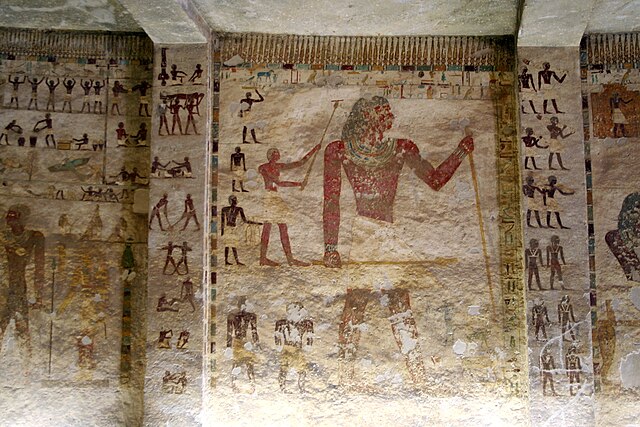
Of all the traditions, rules, and geometric inventions of Egyptian art, one has influenced modern understanding of art and perception more than any other—the composite view. You’ve seen it time and time again; the Egyptian figures are painted in different dimensions. Their legs, arms, face, and nose are seen in profile, but their eyes—or eye really, chest, and waist face us. It seems like a weird pose, handy for a contortionist but not for gods and pharaohs.
So why did they do this?
If you want the most idealized version of a person, it makes sense to portray the most representative aspects of their physique instead of opting for realism. The Egyptians might have gotten this idea from sculptures where one can move around and extract information from a three-dimensional plane. The composite view might have been their idealistic attempt at harmonizing painting with the more expansive space of the real world. Doesn’t hurt to speculate.
Power Symbols and Hierarchy of Scale

If a perfect physique presents an image of material perfection, then luxury and regalia reinforce power. The crook and flail you see in almost every picture of an Egyptian king began as items-of-choice for Osiris and eventually became mainstays for the emperors. Not to mention the different hats for Upper and Lower Egypt. But that’s not it.
Nothing reinforces authority like size, and so kings are always drawn much larger than their contemporaries. This hierarchy of scale extends from the smallest paintings to the most overwhelming edifice.
Tombs and Temples, the Egyptian Museums
The pharaoh was divine. That much we have established. He could not cheat death, but he could have a cozy afterlife, hence the mummification process. Since the Egyptians did not want their pharaohs to get bored after death, most ancient Egyptian art comes from the tombs of pharaohs—the relief sculpture on walls, the statues, the funerary paintings, the graves, and the pottery that kept the dead leaders company.

So in a way, most Egyptian art was made for the dead or the mummies of the dead, not for the living. Even most of what we know about ancient Egypt comes from records of funerary rites.
Why this obsession with tombs? Good question. Why are we obsessed with the pyramids? After all, they are only giant, elaborate tombs for dead emperors. And the art we’ve found inside them and other tombs are mostly illustrations of the same sort. Go figure. You might be asking: What became of the common man or woman? Did they get something for their afterlife?
The second most common source of Egyptian art is old temples. The Egyptians were mental about temples—the ones who were allowed to enter them, at least. Their structural remains constitute some of the most sublime images on the African landscape, but the beaten foundations betray our moral compass. Remember how I said that Egyptian society was hierarchical and unequal? The temples, in their original form, were designed to appear rigid and uninviting.

They were constructed to discourage the average man from entering. The priests had to follow a ritualistic path of staircases and ramps to reach the sanctuary. Outside of priests, only royals were granted admission. As for the sanctuary, the temple’s highest and most sacred point, only the king and the high priest had access. A door from the sanctuary led to another chamber, one with a cult statue of a god or goddess.
The temples from the Middle Kingdom and afterward had avenues to accommodate religious processions. There were several statues of gods across these streets—Amun [ram-headed lion], Horus [falcon-headed lion], Anubis [jackal], the pharaoh himself [the human-headed lions], etc. The exteriors of temples had some supporting domestic buildings like kitchens, stables, houses of priests, and so on. There were also statues, painted decorations, and obelisks.
Art as an Eternal Entity
The Egyptian conception of time was wholly different than ours. To the Egyptian pharaohs, death was just a coming-of-age party—a bat mitzvah of sorts. They lived through the experience and had people buried with them in their tombs to serve them in the afterlife. If an emperor was buried without food, he was thought to starve in the afterlife. This theme of timelessness is pretty on-brand for the culture when you think about the mummies and the pyramids, two things that have pretty much walked through death. How have these objects persevered through thousands of years and will probably persist for thousands more?Art was no different. It was a complement to the broader ideas of life beyond death, of walking through death into a realm of timelessness. And to their credit, a lot of their art did. But, keeping that worldview in mind, it becomes a lot easier to understand why there was no need to enhance their artistic pantheon. It was, like them, eternal.
Leave a Reply to Why Ancient Egyptian Art Failed to Evolve Across Millennia – Culture PassportCancel reply